
A $499 toothbrush with a camera, 16 million lines of code and 661 engineers behind it is absurd, until you look at what it took to build. Canada has more tech workers per capita than almost anywhere in North America. The question is what they're building.
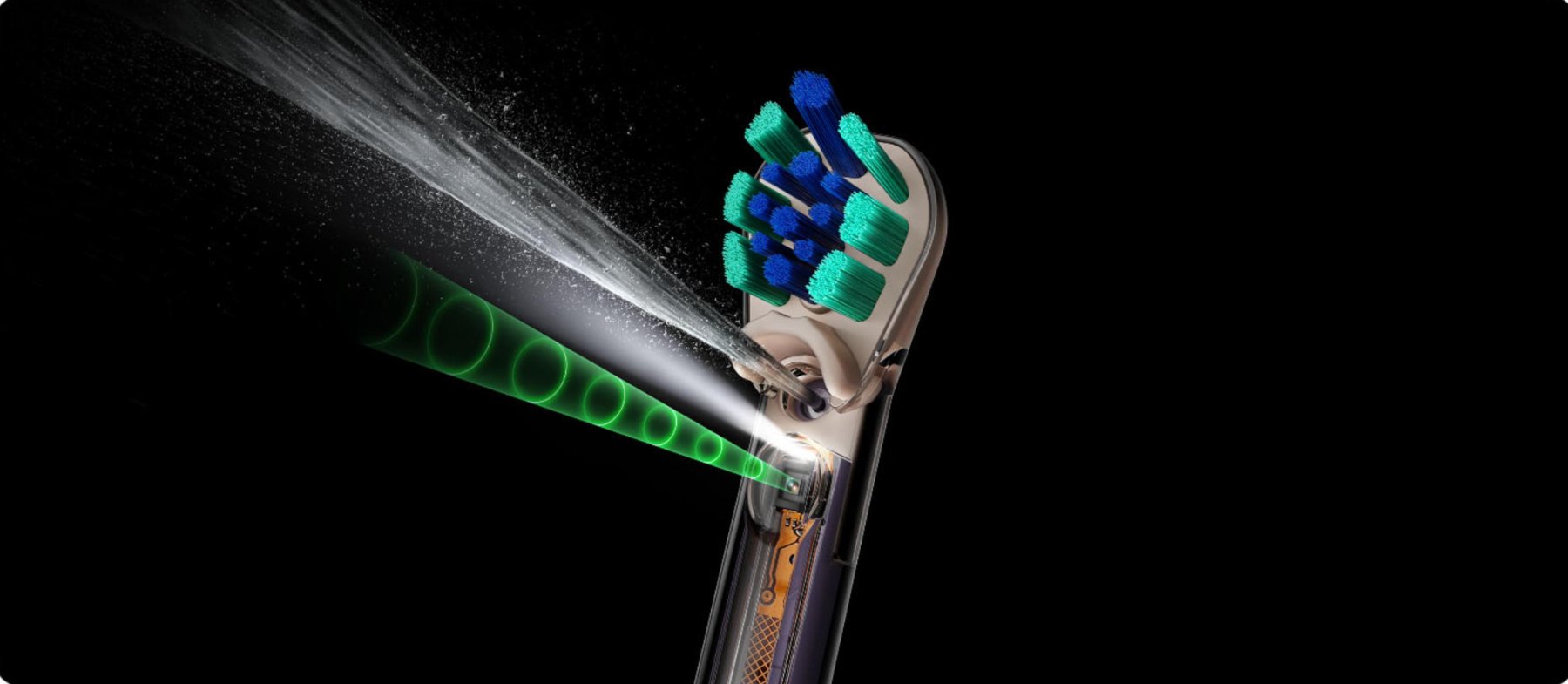
Dyson launched the CameraJet on September 1. It is a toothbrush. It costs $499. It contains a 1mm embedded camera that scans your mouth 28 times per second, an AI system trained on 470,000 dental images, a proprietary algorithm called Gap Optical Targeting that identifies spaces between teeth within 100 milliseconds, and a precision jet that fires Dyson formulated mouth rinse into those gaps while you brush. The company developed a new toothpaste because conventional formulas foamed too much for the camera to see through.
Six years of research. Thirty eight patents. Sixteen million lines of code. Six hundred and sixty one engineers. A five year partnership with the National University of Singapore's dental faculty to develop synthetic plaque for testing. An anti gravity mouth rinse tank with a diaphragm pump. RFID tagged brush heads that track their own replacement cycles. WiFi and Bluetooth connectivity streaming diagnostic data to an app.
The reasonable reaction is that this is ridiculous. A toothbrush does not need artificial intelligence. The more instructive reaction is to notice what Dyson actually did: it took an everyday object, treated it as an unsolved engineering problem, and committed the R&D intensity of a defence contractor to a consumer product selling for under $500. That commitment, not the toothbrush, is the story.
What the CameraJet Reveals About the Product Economy
Dyson is a British company that makes vacuum cleaners, fans, hair dryers and now a toothbrush. It does not license technology. It does not outsource R&D. It does not release minimum viable products and iterate. It spends years engineering proprietary systems, files dozens of patents, and enters consumer categories at premium price points with products built on accumulated intellectual property.
The hair care line followed the same pattern. Dyson spent four years and $71 million developing the Supersonic hair dryer before its 2016 launch. The CameraJet extends that philosophy: identify a daily consumer behaviour that existing products serve poorly, invest disproportionate engineering resources, and create a product whose technical barriers discourage imitation.
The approach works because Dyson controls the entire value chain from research through manufacturing. The AI, the optics, the fluid dynamics, the chemistry and the materials science all stay in house. Each patent protects a component. Together, they protect a system.
That model of product development, deep R&D, proprietary technology, vertical integration, premium consumer positioning, is precisely where Canada's technology sector has a gap.
Canada's Tech Strength and Its Missing Layer
Canada has the talent. The CBRE Scoring Tech Talent report ranked Toronto the third largest tech hub in North America in 2026. Vancouver placed ninth. Waterloo tenth. Six Canadian cities landed in the top 15. Canadian tech employment grew 7.6 per cent, adding roughly 91,300 new jobs. Across the United States and Canada combined, AI specialty workers jumped 45 per cent year over year, with Toronto, Montreal and Vancouver holding 60 per cent of Canada's total.

The infrastructure exists too. Kanata North, in Ottawa's west end, houses more than 800 companies across semiconductors, AI, cybersecurity, defence tech, cloud computing and digital health, supporting 63,000 jobs and generating $17.9 billion in economic output. Communitech in Waterloo, MaRS Discovery District in Toronto, and the AI research corridors anchored by the Vector Institute, Mila and Amii represent institutional depth that most countries cannot match.
What Canada builds with those resources is overwhelmingly enterprise software, cloud platforms and B2B services. Canadian tech companies write code for other businesses. They build tools, infrastructure and middleware. They build for the layers of the economy that consumers never see.
What they rarely build is the thing Dyson just built: a physical consumer product engineered from scratch, protected by patents, manufactured at scale, and sold directly to households. Canada's business R&D spending has trended downward as a share of GDP for more than two decades. By 2022, Canada ranked second lowest among G7 nations for business R&D intensity, even as BERD rose in absolute terms to $30.4 billion. Foreign controlled firms accounted for roughly a third of that spending despite representing under 15 per cent of total business assets. Canadian companies, on average, spend less on research than their competitors in every peer economy.
The Toothbrush Test
The CameraJet is not a template Canada should copy. Canadian companies do not need to make AI toothbrushes. But the engineering philosophy behind it, commit to deep R&D, build proprietary systems, protect the intellectual property, control the product, is a philosophy Canada's tech ecosystem has not widely adopted.
Shopify led Canadian companies with $1.96 billion in R&D spending in 2022. Xanadu, the Toronto based quantum computing company, won Canadian Business's 2026 Innovation Award for Aurora, a networked photonic quantum computer. Better Battery Co. won for sustainability. These are serious companies doing serious research. They are also exceptions in an economy where most technology firms optimize for capital efficiency rather than deep product development.

If Canadian tech companies and the institutions supporting them, the research parks, the accelerators, the universities, the public funding agencies, begin rewarding the kind of multi year, patent protected product development that Dyson practises, the country's tech infrastructure becomes a product economy, not just a services one. If the incentive structure continues to favour quick to market SaaS platforms and enterprise tools, the talent stays world class and the products stay foreign.
What Comes After the Platform
Canada's tech parks house the engineers. Its universities train the researchers. Its AI corridors produce the science. The missing piece is a product culture, an ecosystem that treats consumer hardware, applied materials science, proprietary chemistry and physical manufacturing as worthy of the same venture capital, public investment and institutional prestige that software receives.
Dyson put 661 engineers on a toothbrush for six years because the company's founder believes physical products deserve that commitment. Canada does not need to believe in AI toothbrushes. It needs to believe that its tech talent can build things people hold in their hands, and that those things deserve the same resources, patience and ambition the country already gives to code.
The CameraJet will sell or it won't. What it demonstrates is harder to dismiss: a company that treats R&D as a competitive weapon rather than a cost centre can turn any category into a technology product. Canada has the weapon. It has not yet decided what to aim it at.