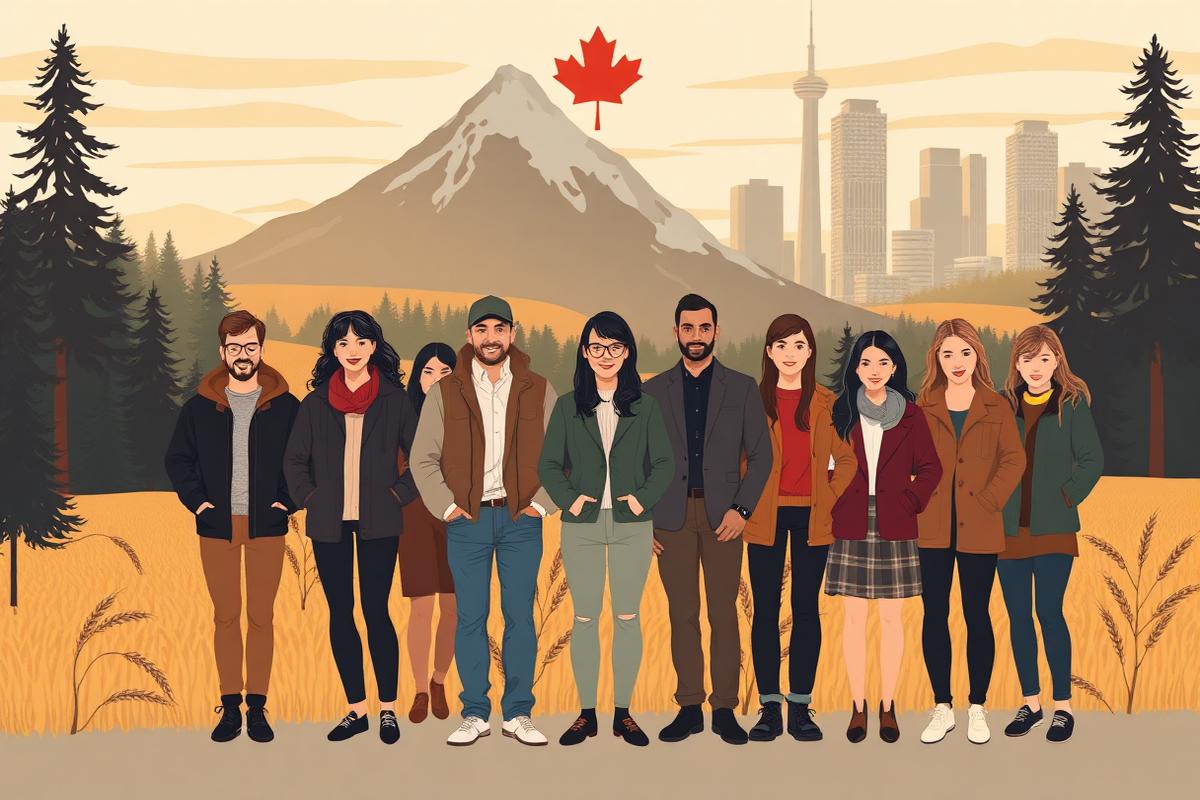
What makes someone Canadian? In 2026, the answer is not what it used to be. A changing population, evolving culture and a new fearless generation are redefining Canadian identity — and shaping the Canada that comes next.
Ask a Canadian to define their country and you will rarely get the same answer twice. To some, Canada is wilderness, hockey and maple syrup. To others, it is multicultural neighbourhoods, universal healthcare and an apology reflex so strong it has become a national punchline. To a growing number, it is a place still grappling with the weight of its colonial history while trying to build something more honest and inclusive.
Canadian identity has always been less a statement than a conversation. It is shaped by geography, weather, politics, immigration and time. And right now, that conversation is louder than it has been in decades.
The idea of Canada before Canada
Long before Confederation in 1867, the land now called Canada was home to hundreds of distinct Indigenous nations, each with its own languages, laws, governance systems and spiritual relationships to territory. The Métis Nation emerged as a distinct people in the Prairies. Inuit communities thrived across the Arctic. These were not pre-Canadian societies waiting to become Canada; they were — and remain — foundational to what Canada is.
European colonization imposed new borders, names and hierarchies. The French established settlements along the St. Lawrence River. The British followed, eventually defeating French forces on the Plains of Abraham in 1759. The two colonial powers left behind a linguistic duality that still defines Canadian politics, from official bilingualism to the distinct society of Quebec.
The Canada that emerged in 1867 was a compromise: a federal state stretched across a vast territory, borrowing British parliamentary structures, preserving French civil law in Quebec, and claiming Indigenous lands through treaties that are still being contested and reinterpreted today.
Multiculturalism as policy — and as practice
In 1971, Canada became the first country in the world to adopt multiculturalism as official policy. Prime Minister Pierre Trudeau framed it as a way to manage diversity without forcing assimilation. The idea was simple, even radical: Canadians did not need to surrender their heritage to belong.
That policy turned into something far more organic in cities like Toronto, Vancouver and Montreal. Today, more than one in five Canadians was born outside the country. In the Greater Toronto Area, over half the population identifies as a visible minority. The idea of a single, dominant Canadian culture has given way to something messier and more interesting: a culture made of overlapping cultures.
This is where Canadian identity gets complicated. Multiculturalism has been celebrated as a strength and criticized as a way to avoid deeper conversations about power, racism and inequality. For many Canadians, the question is no longer just "who gets to belong?" but "who has been excluded, and what do we owe them?"
The symbols that bind — and the ones that divide
Every national identity needs symbols, and Canada has plenty. The maple leaf. The Mountie. The canoe. Hockey night. Tim Hortons. The CBC. The northern lights. These images circulate in advertising, tourism campaigns and political speeches, creating a shared visual language even when the meanings differ.
But symbols can also obscure. The friendly, apologetic Canadian stereotype can flatten a country that includes fierce protest movements, radical artists, bitter regional resentments and deep class divides. The image of Canada as a peacekeeping nation sits uneasily with its arms sales, environmental record and treatment of Indigenous peoples.
In recent years, Canadians have become more willing to question their own mythology. The discovery of unmarked graves at former residential schools forced a national reckoning. Climate disasters have exposed infrastructure vulnerabilities. The housing crisis has challenged the idea of Canada as an easy place to build a life. These ruptures are painful, but they are also signs of a country mature enough to examine itself.
Regional identities: coast to coast to coast
Canada is the second-largest country on earth, and its geography has never allowed for a single national character. Atlantic Canada carries its own rhythms, dialects and histories of fishing, shipbuilding and out-migration. Quebec maintains a distinct civil society, language and cultural industry. Ontario is often treated as the political and economic centre, even as resentment toward Toronto builds in every direction. The Prairies blend agricultural conservatism with resource-industry volatility. British Columbia faces the Pacific and thinks about Asia, climate and real estate in ways that set it apart.
Then there is the North — Yukon, the Northwest Territories and Nunavut — where Indigenous leadership, climate change and resource extraction collide in real time. The North is not a frontier to be settled; it is a homeland with its own priorities and voices.
These regional differences are not quirks. They are structural features of a federation that asks people to share a country while living in radically different conditions. The tension between local and national belonging is one of the things that keeps Canadian identity dynamic.
A new generation rewrites the script
Young Canadians are coming of age in a country transformed by technology, migration and climate anxiety. They are more likely than their parents to identify as racialized, LGBTQ+, secular or politically progressive. They consume culture globally but produce it locally. They are fluent in the language of identity, privilege and systemic inequality.
This generation is also more willing to challenge the institutions that previous generations treated as permanent. They question the monarchy. They push for climate action. They demand accountability on reconciliation. They do not assume that Canada is automatically good; they want it to prove it.
That skepticism can be read as disloyalty, but it is better understood as a different kind of patriotism: the belief that a country is worth criticizing because it can be improved.
So what makes someone Canadian?
There is no final answer, and that may be the point. Canadian identity is not a birthright, a passport or a checklist of traits. It is a relationship — to land, to history, to other people and to an ongoing argument about what the country should become.
Citizenship matters, but it is not the whole story. A newcomer who builds a life in Winnipeg can be as Canadian as a sixth-generation Montrealer. An Indigenous person whose nation predates the state can be Canadian while also refusing the label. A Quebecker can feel Canadian in Ottawa and not in Quebec City. Identity here is layered, situational and contested.
What holds it together is not agreement but a shared stake in the question. Canadians argue about their country constantly — in Parliament, on Twitter, in hockey rinks, in classrooms and around dinner tables. That argument is the identity.
Where CR fits in
At Cultural Renaissance, we believe Canadian identity is something to be reported on, not declared. Our coverage follows the people, places and movements that are moving the culture forward — sometimes by preserving tradition, sometimes by breaking it. We are interested in the Canada that exists and the Canada that is being built.
This page is a living entry point into that work. Explore our reporting on culture, business, travel and city tours for more of the stories shaping the country.