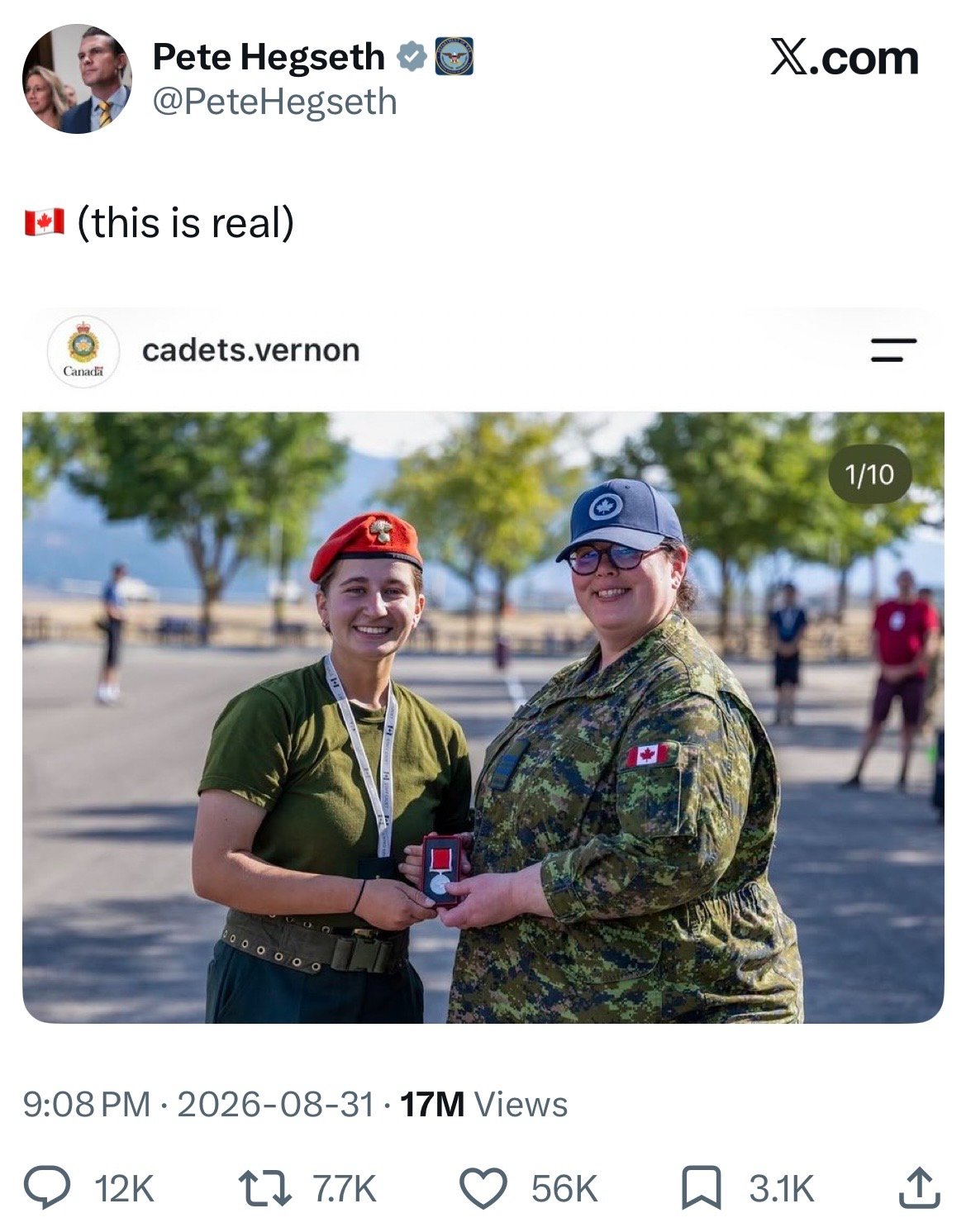
The U.S. Defence Secretary posted a photograph from a Canadian youth program and seemingly implied that it represented the country's military. The insinuation was dishonest. The reason it found an audience is the part Canada needs to address.
The photograph Pete Hegseth presented to millions of followers as an apparent reflection of Canada's military did not show a combat unit. It showed an officer in the Cadet Instructors Cadre presenting an award to a young cadet at the Vernon Cadet Training Centre in British Columbia. Cadets participate in a federally funded youth development program for Canadians aged 12 to 18. They are not members of the Canadian Armed Forces.
Hegseth posted the image late on August 31 with a Canadian flag emoji and the parenthetical words "this is real." The Pentagon's deputy press secretary said the post spoke for itself. Prime Minister Mark Carney said the comments were beneath their office. Defence Minister David McGuinty condemned the post. The Army Cadet League of Canada called the resulting online harassment of cadets and volunteer instructors unacceptable.
The factual deception deserves the condemnation it received. But treating the incident only as a question of manners misses the harder problem: the post suggests that a cabinet level American official expected little diplomatic cost for ridiculing Canada.
Why Hegseth's Canadian Cadet Post Resonated
Hegseth's post did not prove that Canada's military is weak. It drew on an established perception of weakness, and the engagement it generated showed how readily that perception travels.
That assumption did not appear from nowhere. For more than two decades Canada spent well below the NATO guideline of 2 percent of GDP on defence while depending heavily on American capabilities for continental defence, intelligence sharing and strategic lift. The Canadian Armed Forces reported a Regular Force shortfall of 3,027 personnel as of July 31, 2026, roughly 68,500 members against an authorized strength of 71,500. A January 2026 retention evaluation documented concerns involving equipment availability, training resources and leadership direction. Major procurement programs, from surface combatants to fighter jets, have moved slowly enough to become shorthand for institutional dysfunction.
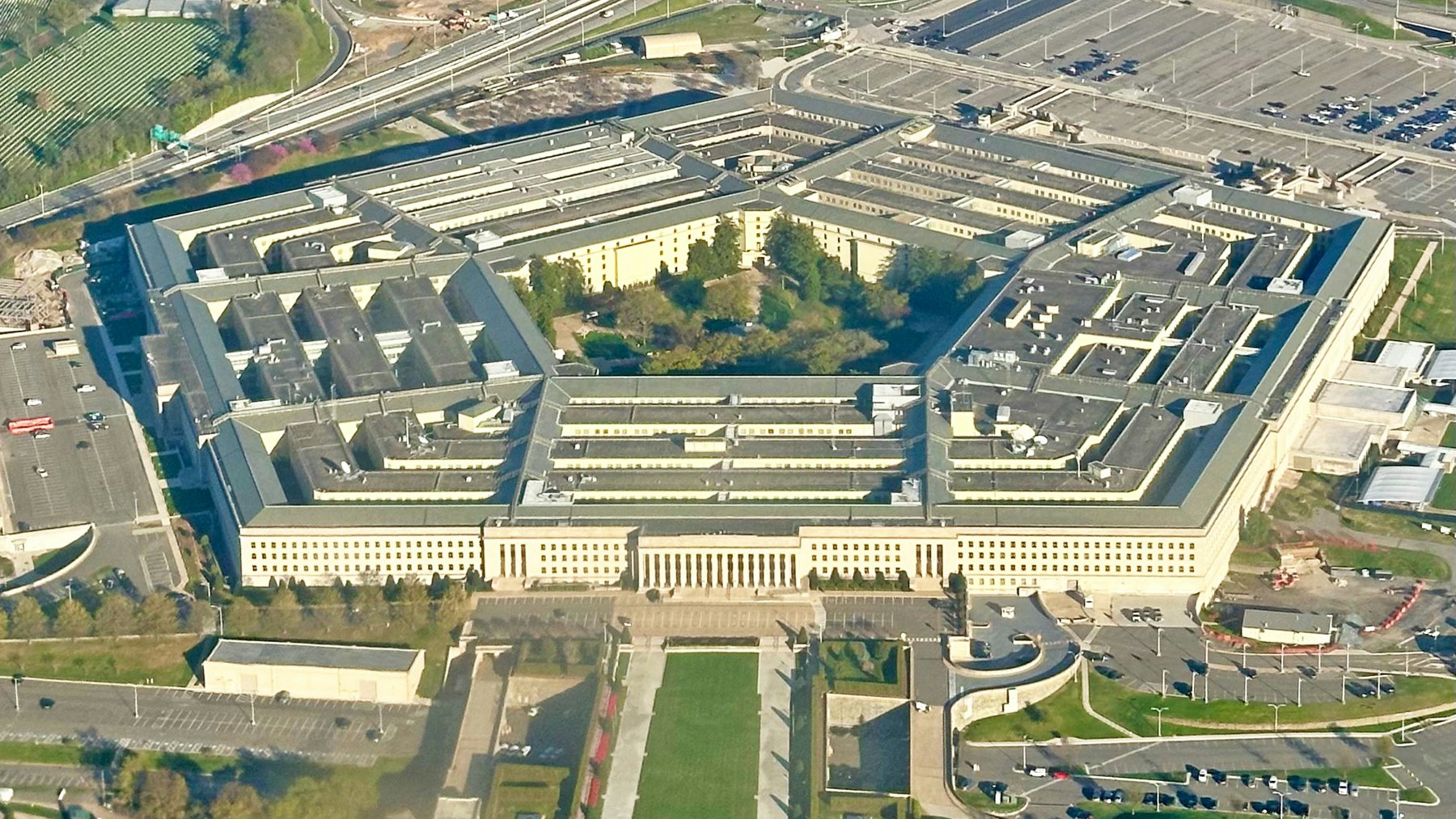
The relationship with Washington has deteriorated in parallel. In May 2026, the Pentagon paused its participation in the Permanent Joint Board on Defense, the senior bilateral defence advisory body operating since 1940. The stated reason was that Canada had failed to make credible progress on defence commitments. Other senior American officials have publicly questioned Canadian military seriousness. Hegseth's post arrived inside that pattern, which is why it landed as more than a tasteless joke.
Yet the pattern is not the whole picture. On March 26, 2026, Ottawa announced that Canada had reached the NATO 2 percent spending benchmark for fiscal 2025 to 26, a figure NATO has since confirmed. Canada also committed to the alliance's 2035 target of 5 percent of GDP, 3.5 percent for core defence and 1.5 percent for broader security investments. More than 3,000 CAF members support Operation REASSURANCE through the year, Canada's largest current international deployment, and the Canadian led multinational brigade in Latvia comprises personnel from 14 NATO nations. In July 2026, Canada extended that mission through 2031 and assumed expanded responsibilities as a framework nation for NATO's Multinational Division North. Senator Ruben Gallego, a Democrat and former Marine, called Hegseth's rhetoric "stupid" and "deeply disrespectful." Conservative MP Garnett Genuis reminded audiences that 158 Canadian military members died in Afghanistan.
What the evidence supports is contested credibility, not national worthlessness. Canada possesses real capability and serious commitments. It also carries years of accumulated evidence that spending announcements and operational readiness are not the same thing.
What Respect Would Require
Condemnation answered the insult. It did not address the vulnerability that made the insult seem plausible. Four tests would.
First, convert budgets into fielded capability. Canada has reached the 2 percent threshold. The next measure is whether that money produces trained personnel, serviceable platforms, sufficient ammunition, modern infrastructure and forces that can deploy when called. If Canada can sustain 2 percent spending and begin closing the Regular Force gap, CR's proposed benchmark: measurable progress within two years, it enters alliance discussions with evidence rather than promises. If the money flows without reaching operations, the spending figure becomes another announcement.
Second, make Arctic and continental defence visible. Sovereignty claims mean little without surveillance, logistics, presence and NORAD modernization. The commitments exist on paper. NORAD modernization funding has been announced but key radar and sensor upgrades have not yet reached operational status, and northern basing and logistics infrastructure remain limited relative to the geography Canada claims to defend.
Third, build strategic options. Canada's Defence Industrial Strategy, launched in February 2026, aims to expand domestic production and deepen partnerships with European and Indo Pacific allies. Partnerships that produce interoperable capability and procurement alternatives would turn Canadian dependence on a single ally into a choice rather than a constraint. Without operational substance, the agreements stay decorative.
Fourth, protect the culture of service. The cadet program exists to develop citizens, not to produce infantry. Defending it against mockery is not sentimentality. A country confident enough to invest in the development of young people, including young women, should not need to apologize for what that investment looks like. National seriousness is built through institutions that form capable citizens, not through leaders who humiliate them for attention.
The Cadet and the Country
The young person in Hegseth's photograph was receiving recognition for completing a training program. She should not have been made to carry the burden of Canada's defence record. Canadian governments are responsible for that record, and now for the rebuilding.
Contempt for Hegseth's post is warranted. It is not a defence policy. The spending is new, the commitments are fresh, and the gap between budget lines and operational reality remains wide. Closing it is the work that matters, not because an American official posted a misleading photograph, but because Canadians deserve armed forces as serious as the people willing to serve in them.