
South Korean consumers are flocking to fake shopping and food delivery websites, platforms designed to simulate the thrill of buying without spending a cent. The sites have drawn tens of thousands of users and spread to English speaking markets. What sounds like a joke is actually a mirror. The popularity of pretend consumption says something uncomfortable about what real consumption has become.
Open a delivery app on your phone right now. Scroll through the restaurants. Pick something. Add it to the cart. Feel that small, warm pulse of anticipation, the meal is almost yours. Now close the app. Order nothing. Eat nothing. According to a growing number of South Koreans, you just got the best part.
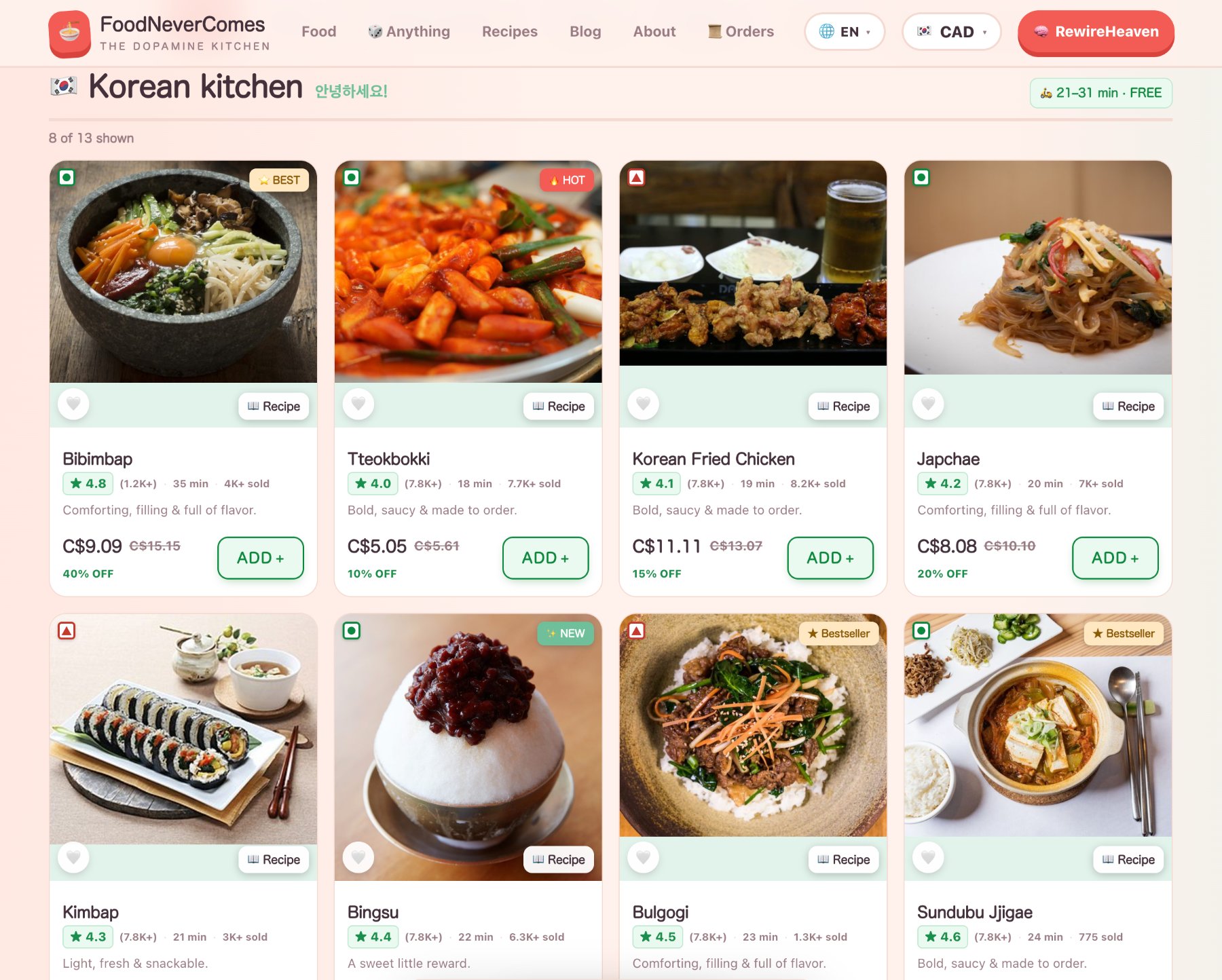
Welcome to the world of dopamine sites: websites and apps that replicate online shopping or food delivery without completing a single transaction. You browse menus. You add items to a cart. You check out. A fake courier begins a fake journey across a fake map. Nothing arrives. Nothing was ever going to arrive. The satisfaction, supposedly, is already complete.
Where This Started
The trend emerged in South Korea in early 2026. A developer who goes by Malhee built FoodNeverComes, a site that mimics food delivery apps down to the menus, reviews and tracking screens. Malhee explained the idea came from repeatedly opening delivery apps out of habit, not hunger, and wanting to break the pattern. A 27 year old developer named Park Seo hyun, who said she had been ordering delivery ten times a week, launched a competing site called FoodNeverArrives in late March. By mid June it had roughly 30,000 weekly users.
Others followed. Sajasaja offers fantasy shopping for imaginary products inspired by the manga series Doraemon. DopaHaul seems to replicate the full Temu experience, from search to checkout, with no real payment and no shipment. An English language ecosystem has begun to form around the concept, with clones and variations appearing on app stores and independent websites across North America.
If you have ever sat on your couch adding shoes to a cart you never checked out, you already understand the mechanic these sites exploit. The dopamine does not arrive with the package. It arrives with the anticipation.
The Science Behind the Scroll
Neuroscience supports the premise, at least partially. Dopamine activity in the brain's reward system spikes during anticipation, before a reward is received, not after. Mental simulation of a future experience can generate genuine emotional responses. This is why browsing a travel site feels good even when you cannot afford the trip, and why cooking shows hold audiences who will never make the recipe. The brain does not always distinguish sharply between imagining a reward and obtaining one.
Kelly Haws, a consumer behaviour researcher at Vanderbilt University, called the concept "fascinating" but expressed doubt about its durability. "I have some doubts about how well it will work with people once the novelty wears off," she told Moneywise. Haws raised a sharper concern: simulated consumption could prime real consumption rather than replace it. "What's a stronger dopamine hit than pretending to eat? It's actually doing it."
Most Canadians do not think of themselves as compulsive shoppers. But the research suggests the behaviour is far more common than the label implies. An estimated 13 million Americans are said to experience so called “compulsive buying disorder”. A 2006 study in the American Journal of Psychiatry estimated the prevalence at roughly five per cent of the adult population. Online retail has almost certainly pushed that figure higher, though updated data remains thin.
What Consumer Culture Built
When I think about what dopamine sites reveal, what strikes me is not the sites themselves. It is the economy they respond to. South Korea's online shopping sales reached 25 trillion won in May 2026, a ten per cent year over year increase. Consumer inflation hit 3.2 per cent in June, a 30 month high. Korean consumers are spending more, feeling the squeeze, and turning to simulated purchases as a pressure valve.
Kwak Keum joo, a psychology professor at Seoul National University, told the Korea JoongAng Daily that the sites address a specific modern tension. "Today, we're constantly encouraged to consume," Kwak said. Recommendation algorithms, push notifications, influencer endorsements and one click checkout have made buying frictionless. The dopamine sites reverse the equation. They keep the ritual and remove the consequence.
The comparison to nonalcoholic beer is instructive. Users on Reddit's shopping addiction forums have drawn exactly that parallel: a substitute that scratches the itch without the damage. For mild habits, that framing may hold. For deeper compulsive patterns, psychologist Susan Albers has cautioned that virtual solutions do not address the emotional triggers driving the behaviour. The fake cart does not ask why you needed it.
What Canada Should Watch
The dopamine site trend has not reached significant scale in Canada. But the conditions that produced it in South Korea, algorithmic shopping, rising living costs, frictionless digital spending, a generation raised on delivery apps, exist here in nearly identical form. If you have ever deleted the Uber Eats app on a Sunday evening only to reinstall it by Wednesday, you understand how deeply the habit loop runs.
The cultural question is worth sitting with. A generation ago, consumer anxiety meant worrying about whether you could afford what you wanted. Today it increasingly means worrying about whether you can stop buying what you do not need. The dopamine sites invert the old problem. They are not tools for people who cannot afford to shop. They are tools for people who cannot stop.
If dopamine sites retain users beyond the first month and platforms like South Korea's integrate them with spending limit tools and cognitive behavioural resources, they could become one piece of a broader effort to make digital consumption less compulsive. If they lose most users within weeks, as Haws suspects, while the algorithms that drive real spending grow more sophisticated, they become a footnote: a clever idea that diagnosed the disease without treating it.
The diagnosis, though, is worth something. Thirty thousand South Koreans are using a fake delivery site because the real one trained them to need it, and they want a way out that does not require deleting the phone itself. That desire to reclaim control from a system designed to prevent exactly that deserves more than a novelty app. It deserves a serious conversation about what digital commerce has done to the human capacity for restraint.