
Five scripted projects in development. A strategic partnership for unscripted content. Representation by 3 Arts Entertainment. Self financed by the founders. And no publicly announced buyer, commission, greenlight, production start or release date for any of it.
That is the state of Hope & Hard Work, the development and production company that Justin Trudeau and Katie Telford launched at the Toronto International Film Festival on September 11. Named for the phrase Trudeau used in his March 2025 departure statement, the company spans film, television, audio and live experiences. The Obama Netflix comparison arrived within hours, but it obscures the harder question. The Obamas entered a market where American stories already dominated global streaming. Trudeau is entering a market where Canadian stories struggle to become Canadian owned properties.
The Slate
The development slate is anchored in Canadian settings, creators and voices, though not every source work or subject is purely domestic. Closer by Sea adapts Perry Chafe's Newfoundland coming of age novel; Chafe is a writer and producer on Republic of Doyle and Son of a Critch. Detective Aunty, from novelist Uzma Jalaluddin, follows a widowed South Asian mother investigating her daughter's murder accusation in Toronto; the project has been optioned by Neshama Entertainment and producer Todd Berger, with Trudeau and Telford attached as executive producers. Le Collège, an original series created by Jessie Gabe and Shebli Zarghami, whose credits include Workin' Moms, North of North and Kim's Convenience, is set in a Montreal private school.
Backchannels adapts Phoebe Saintilan Stocks's The Right Hand, drawn from interviews with chiefs of staff around the world, and is in development with Chloe Saintilan. Power Moves, a political rom com by Australian author Leesa Ronald, rounds out a slate that draws heavily on Trudeau and Telford's political world.
Earth Tones, founded by Aliya Jasmine and Aliza Sovani, will lead development and production of documentaries and docuseries for the company's unscripted division. 3 Arts Entertainment represents Hope & Hard Work and its principals; that is a packaging and business affairs relationship, not a financing or distribution commitment.
From Development to Production
Self financing development gives the founders control over what they option and package. It does not by itself secure the commissions, distribution agreements, equity partners or public funding that convert a development slate into productions. That gap between optioned material and a financed production is where most projects in the Canadian industry stall. Trudeau told the National Post that the company is "not starting with a big partnership" and can "do the things that we want to do, that we believe in, and not feel like we have to deliver to the powers that be." The creative independence seems sincere. The commercial path remains unproven.
Canada's Screen Industry Paradox
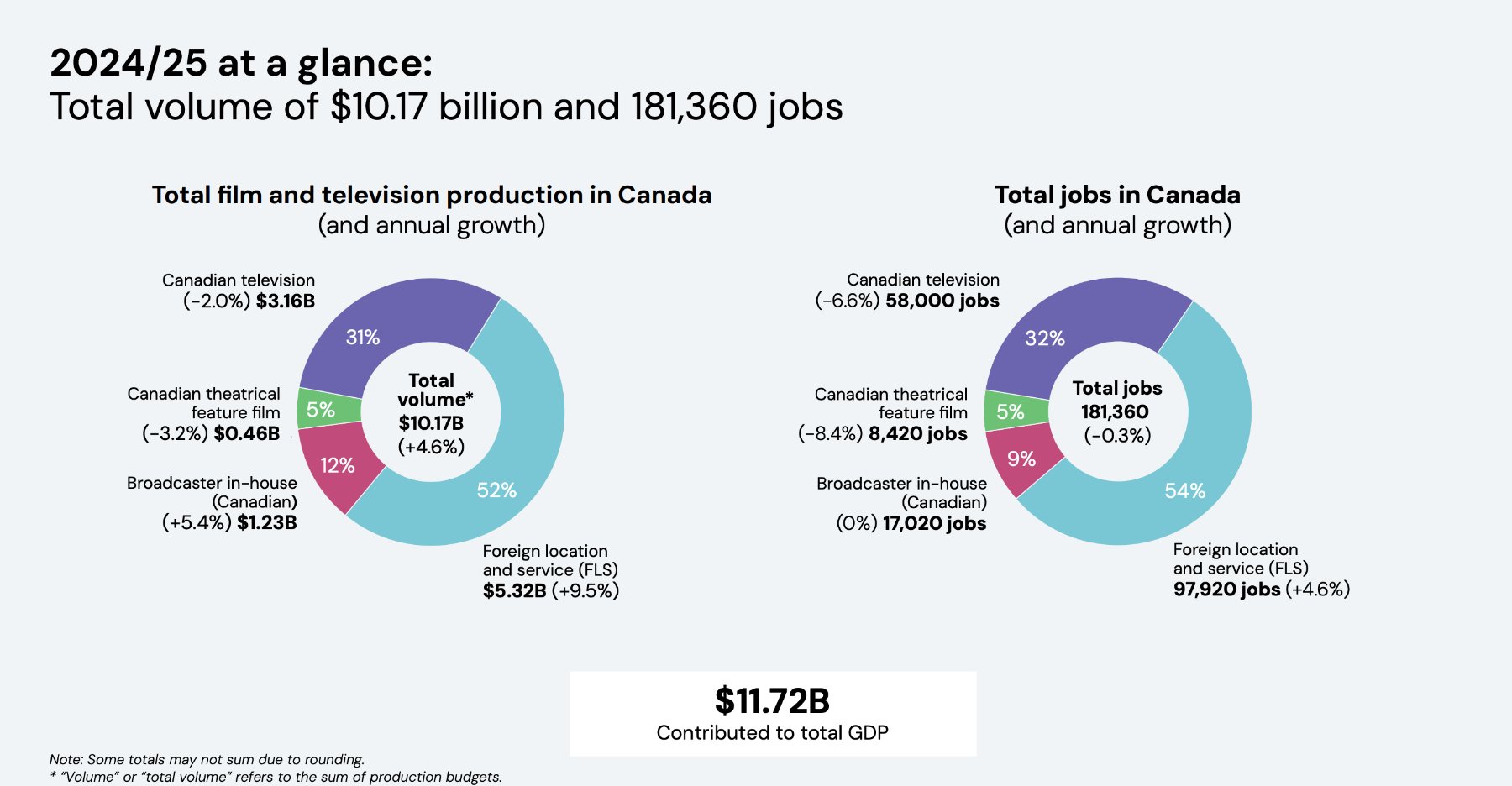
Canada's screen sector is large. The Canadian Media Producers Association's Profile 2025 report records $10.2 billion in total production volume for 2024 25 and 181,360 jobs. But total volume and Canadian owned cultural capacity are not the same measure. Foreign location and service production reached $5.32 billion after a 9.5 per cent increase. Canadian content production fell to $3.62 billion, a 2.2 per cent decline and the second consecutive year of contraction. Canada builds sound stages, trains crews, offers tax credits and hosts international shoots. That activity creates real economic value. It does not automatically build Canadian owned catalogues.
The audience data reinforce the structural concern. In 2023, non Canadian titles accounted for 85.4 per cent of all film and video distribution revenue in Canada, according to Statistics Canada. Canadian theatrical films captured 3.3 per cent of the domestic box office that year. On linear television, English language Canadian dramatic content represented roughly 14 per cent of peak hour viewing, according to a Nordicity study commissioned by the CRTC (Canadian Radio television and Telecommunications Commission). Nordicity identifies a core problem: Canadian audiovisual production operates largely as fee for service, leaving domestic companies without intellectual property control or long tail revenue. Producers, regulators and industry analysts have flagged weak Canadian IP retention as a structural barrier, even as the production sector grows.
Regulatory Uncertainty
Hope & Hard Work is launching during a live dispute over who should pay for Canadian programming. On May 21, 2026, the CRTC announced a modernized framework requiring non Canadian online streaming groups with at least $25 million in annual Canadian broadcasting revenue to direct 15 per cent of that revenue to Canadian programming expenditures, including the existing 5 per cent base contribution. Groups with at least $100 million were required to allocate 30 per cent of those expenditures to enhanced partnerships with Canadian independent producers holding majority copyright.
On June 3, the federal government directed the CRTC to review the decision, announcing $600 million in annual public funding to replace the contributions it considered at risk of raising consumer prices. By late July, a federal court filing confirmed the government's intention to eliminate the base contribution requirement entirely and develop new policy directions. As of September 14, the final funding model, contribution levels and partnership conditions remained unresolved. The incentive structure that will determine whether Canadian owned IP gets more or less support from the streaming economy has not been settled.
Four Tests
Hope & Hard Work will be measured by outcomes that no amount of celebrity attention can substitute. The first test is whether any project on the slate receives a commission or greenlight from a buyer. The second is whether the resulting deals preserve Canadian majority copyright and valuable downstream rights, including international sales, sequel and format rights. The third is whether finished productions attract Canadian audiences. The fourth is whether the work travels beyond Canada.
Trudeau's public profile can help package projects and reach decision makers. It also guarantees that many viewers will evaluate the company through a political lens before considering the quality of the work. The announced creative and production partners partly address the founders' lack of production experience. Whether those partnerships translate into commissions and favourable rights terms is the operational question.
The company's name supplies the aspiration. The first commissioned project and its rights deal will reveal the business model.