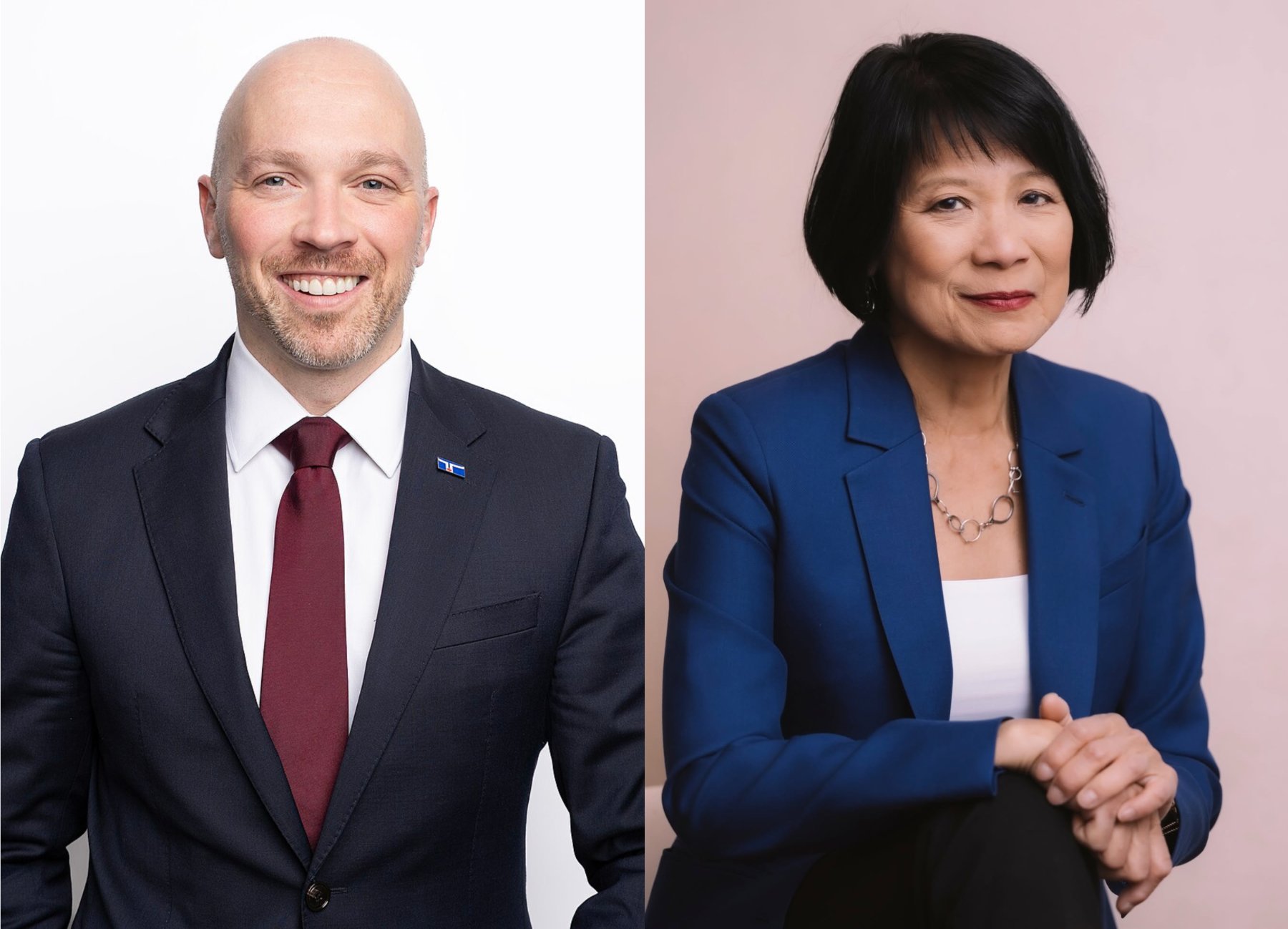
The mayor's record vote confirms the breadth of Toronto's progressive coalition. It also shows how permanent political networks can convert support into turnout, and how far her opponents remain from building comparable infrastructure.
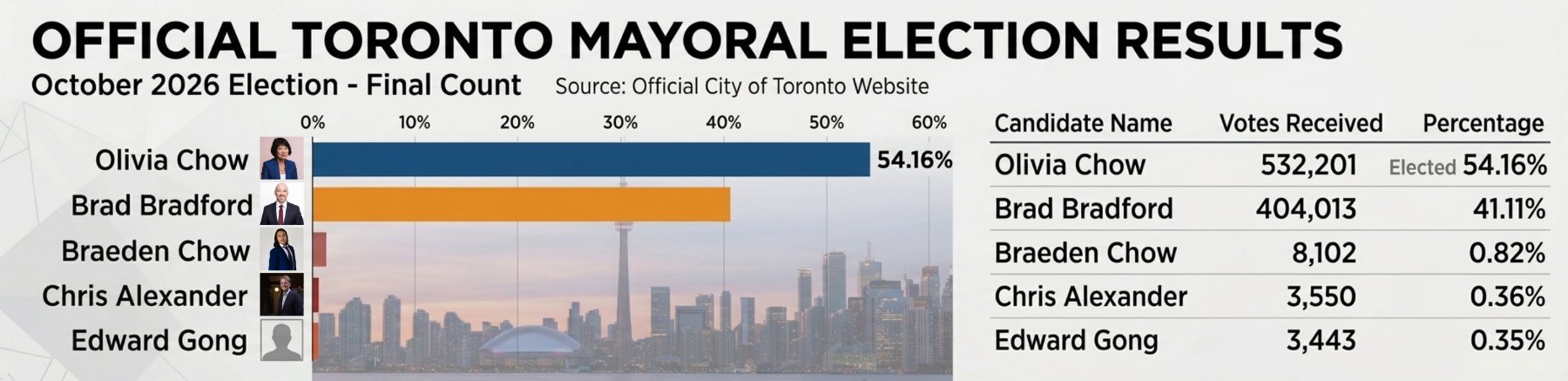
Olivia Chow won 532,201 votes on October 26, the largest raw total received by a Toronto mayoral candidate. She carried 54.2 per cent of valid mayoral votes and 19 of 25 wards, stretching from the downtown core through every Scarborough ward and into inner suburban districts that were supposed to be competitive. Bradford finished with 404,013 votes and 41.1 per cent, the highest vote share won by a challenger to an incumbent Toronto mayor since amalgamation.
The margin was 128,188 votes. It was decisive, and it was not self explanatory.
The Turnout That Complicates the Story
The City Clerk certified 989,990 ballots cast in the 2026 election. Final voter statistics, including the official number of eligible electors after revisions to the voters' list, had not yet been published. Using the preliminary registered elector figure of 2,143,771 produces estimated turnout of approximately 46.2 per cent. Either way, participation was substantially higher than the 29.7 per cent recorded in 2022 and the 38.5 per cent in the 2023 mayoral by election, making this Toronto's strongest municipal turnout since 2014.
The complication runs the other direction. Even in a competitive two candidate contest, a majority of registered electors stayed home. Chow's record total amounts to approximately one quarter of the preliminary registered electorate. Her 532,201 votes equal about 24.8 per cent of that preliminary denominator.
That does not diminish what she earned among the people who voted. But talk to enough Torontonians in any neighbourhood and you meet the other majority: the ones who never looked up their polling station. A well organized coalition holds disproportionate power in a system where more than half the city sits out.
What the Map Actually Shows
The ward results complicate the familiar story of two Torontos, a progressive downtown against a conservative suburbia. Chow did not erase that divide, but she crossed it selectively.
Her sweep of all five Scarborough wards was the campaign's most consequential geographic achievement. Chow campaigned there on transit service, rental housing and public investment, while endorsements from several Scarborough Liberal MPs broadened the public coalition surrounding her. The results show that the message travelled; without exit polling, they cannot establish which part of it persuaded individual voters.
Bradford's six wards, concentrated in parts of Etobicoke and North York, reveal a substantial constituency receptive to his emphasis on affordability, congestion, public safety and value for taxes. They do not establish that every voter in those wards shared the same priorities.
Several of Chow's non core wins were narrow. Shift a few points in Etobicoke North, St. Paul's, York South Weston or Don Valley North and the map looks considerably less dominant. The progressive coalition is currently broader, yet not invulnerable.
The Organizations Behind the Majority
Election results cannot isolate how many votes came from policy approval, incumbency, candidate preference or organizational activity. But the visible infrastructure surrounding the campaigns was markedly different, and that asymmetry offers one explanation for why Chow's support translated so efficiently across the city.
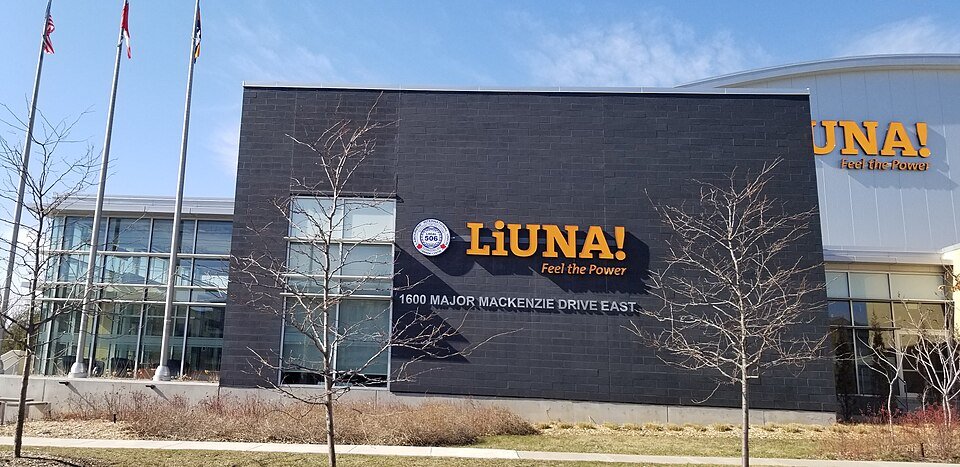
Walk through the list of groups that backed Chow and what emerges is not a single endorsement but a layered operation. Progress Toronto supplied a tested advocacy and volunteer network active since before the 2023 by election. The Toronto and York Region Labour Council endorsed Chow alongside a broader council slate and deployed canvassers across targeted wards. LiUNA Local 183, a construction union representing more than 70,000 members, added visible industry sector backing.
The Automotive Parts Manufacturers' Association provided a voice from outside the traditional labour left orbit. Several Liberal MPs in Scarborough and Don Valley constituencies broadened the coalition's public profile, while New Democrats, aligned councillors and community organizations reinforced the familiar base.
The point is coordination, not conspiracy. Each organization has its own membership, priorities and institutional identity distinct from the formal campaign. What they share is practice.
Progress Toronto and organized labour have operated across multiple municipal cycles, recruiting volunteers, knocking on doors, contacting voters and supporting candidates between mayoral campaigns. A Better City Toronto entered the race as a newer counterweight. Publicly available information does not allow a clean comparison of volunteer numbers, doors knocked or voters contacted. The asymmetry is nevertheless visible: Chow was surrounded by several organizations with established ward level experience, while Bradford's supporting coalition was still constructing a comparable vehicle.
Why the Opposition Fell Short
Bradford's 41.1 per cent should stop anyone from calling the opposition weak. He consolidated the non Chow vote after Chris Alexander withdrew from the race on October 6, won six wards and drew endorsements from Liberal MPs, a Conservative MP and A Better City Toronto. He proved that a substantial share of the city is receptive to a message about fiscal discipline, public safety and congestion.
Bradford also had to hold together voters whose priorities do not perfectly align: fiscal conservatives, centrist Liberals, homeowners worried about property taxes, pro housing urbanists and residents whose primary concern is street level disorder.
Spend an evening at a candidates' debate in Etobicoke and you can hear the tension in the room. The complaints about taxes, about encampments, about a city that feels harder to live in are genuine and widely shared. But they do not arrive organized.
Toronto's non progressive voters often behave as an audience waiting for a candidate. The progressive side behaves as a permanent campaign.
Frustration with the direction of city hall can be broad yet politically inert if no organization translates it into membership lists, trusted local messengers, coordinated ward races and election day turnout. Grievance without infrastructure is not a governing strategy.
The Accountability Test
Chow enters her first full four year term with a record vote and an apparently larger bloc of supportive councillors, although the reliability of that coalition will only become clear through council votes.
If housing approvals accelerate, transit service becomes more reliable, street conditions improve and property tax increases stay near the inflation commitments her campaign made, the coalition's organizational superiority will look like governing competence. If those outcomes stall, if the spending rises but the potholes, the shelter crisis and the two hour commutes persist, the same voters who trusted the coalition's promise of investment will start asking what they purchased.
The coalition proved it can win decisively. Delivering the results for voters is what matters next.